
Nedbank advertises a personal loan rate of 10.25%. Capitec says 12.25%. African Bank pushes a 12% marketed tier. Those numbers look like a real comparison. They aren't.
The rate most South African borrowers receive in 2026 sits between 17% and 27%. That gap between the advertised "from" rate and the actual offer rarely gets explained until the pre-agreement quotation lands in front of the applicant.
This article is for the salaried earner making R15,000 to R40,000 a month. The person comparing two or three bank apps on a lunch break, trying to figure out which personal loan won't quietly cost R20,000 more than expected over five years.
Why "From" Rates on Personal Loans Mean Almost Nothing
Every major bank in South Africa publishes a "from" rate. Nedbank leads at 10.25%, matching the prime lending rate as of mid-2026. Capitec follows at 12.25%. Absa starts at 13.75%.
Those numbers exist for marketing. The rate a bank offers depends on credit score, income verification, existing debt, and sometimes how long the applicant has banked with that specific institution.
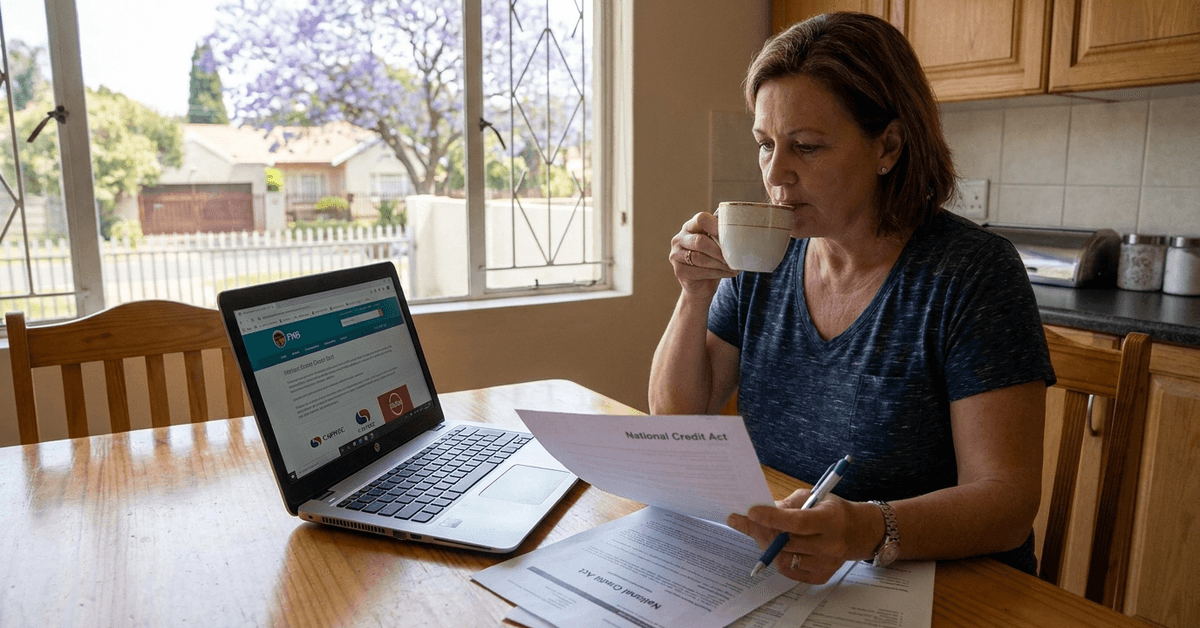
A first-time Capitec loan applicant earning R18,000 a month will almost certainly land above 20%.
The Repo Rate Sets the Ceiling, Not the Floor
The South African Reserve Bank held the repo rate at 6.75% at its March 2026 Monetary Policy Committee meeting. The National Credit Act caps unsecured personal loans using a formula: repo rate multiplied by 2.2, plus 20%.
No licensed lender can charge above that cap. But the cap is so high that the range between the floor rate and the legal maximum leaves enormous pricing room.
Two borrowers applying at the same bank on the same day can receive rates 15 percentage points apart.
What Determines the Rate a Bank Actually Offers
Three factors control the final number. Credit score carries the most weight. A TransUnion score above 600 opens the door to the lower brackets at Capitec. Below 520, the application is likely declined entirely.
Second is debt-to-income ratio. Banks calculate how much of the monthly salary is already committed to existing repayments. The National Credit Act mandates an affordability assessment, and the margin left after expenses determines both approval and pricing.
Third is banking history with that lender. Capitec and FNB both favor existing clients. FNB recently raised its maximum personal loan amount to R450,000 but requires salary deposits into an FNB account.
The Cost That Matters More Than the Interest Rate
I would pick a personal loan with a 16% rate and optional credit life insurance over a 13% loan with mandatory credit life every time. The math supports it at Nedbank's current product structure, and almost nobody talks about this.
The NCA caps credit life insurance at R4.50 per R1,000 of outstanding balance per month. On a R100,000 personal loan, that translates to R450 in the first month alone.
The premium decreases as the balance drops, but over a full 60-month repayment period, the total credit life cost can reach R13,500 or more.
Nedbank Makes Credit Life Optional
Among South Africa's Big Four banks plus Capitec and African Bank, Nedbank is the only major lender that does not mandate credit life insurance on personal loans. The borrower can opt in, opt out, or substitute a cheaper existing policy.
Every other big bank bundles credit life into the monthly instalment. The cost appears on the pre-agreement quotation, but it blends into the total repayment figure. Borrowers comparing only the interest rate column miss this completely.
Running the Numbers on a R100,000 Loan
Capitec publishes a worked example on its official rates and fees page: a R50,000 loan over 48 months at 22% produces a total repayment of R84,811. That includes the R1,207.50 initiation fee, R69 monthly service fee across 48 months, and credit life premiums.
Scale that to R100,000 over 60 months and the credit life cost alone could exceed R13,000. A borrower at Nedbank who skips credit life or substitutes a cheaper standalone policy might save more than the difference between a 14% and a 17% interest rate.
Three NCA-regulated fees apply to every licensed personal loan in South Africa, regardless of the lender:
- Initiation fee: capped at R1,207.50, charged once and typically added to the loan balance
- Monthly service fee: R69 per month, uniform across all NCA-registered lenders, charged for the full loan term
- Credit life insurance: capped at R4.50 per R1,000 of outstanding balance per month when mandatory
On a 60-month loan, the R69 monthly service fee alone adds R4,140 to the total cost. That fee is identical at Capitec, FNB, Nedbank, Absa, and African Bank.
Comparing the Major South African Personal Loan Providers in 2026
The differences between banks go beyond rates. Loan ceilings, approval speed, and credit appetite all shifted in 2026.
| Feature | Capitec | FNB | Nedbank | African Bank |
|---|---|---|---|---|
| "From" rate | 12.25% | 17.5% | 10.25% | 12% (marketed tier) |
| Max loan amount | R500,000 | R450,000 | R400,000 | R350,000 |
| Max term | 84 months | 72 months | 84 months | 72 months |
| Credit life | Mandatory | Mandatory | Optional | Mandatory |
Capitec has the highest ceiling at R500,000 but tightened its credit appetite during 2026 after reporting a credit loss ratio increase from 7.5% to 8.1%. First-time loan applicants face stricter approval criteria than in previous years.
Who Each Bank Quietly Suits Best
Capitec works best for existing clients with an active account and strong in-house banking behavior. The app-based pre-approval process is fast, sometimes delivering a decision within hours.
But the 12.25% starting rate is reserved for top-tier profiles. Expect 18% to 24% for average credit.
FNB favors salaried employees who already receive their pay into an FNB account. The pre-approved limits visible in the FNB app can be generous, but applicants banking elsewhere should not expect the same treatment.
African Bank positions itself around debt consolidation. The 12% marketed tier attracts attention, but qualification depends on the borrower's full credit profile. APR on actual approvals tends to range between 15% and 24.50%.
Mistakes That Cost Borrowers Thousands on Personal Loans
The application itself carries a few traps that repeat across lenders.
Choosing the longest repayment term to lower the monthly instalment feels logical. But a R100,000 loan over 84 months at 22% generates significantly more total interest than the same loan over 48 months.
The monthly payment drops, but the total cost jumps by tens of thousands of rands.
A few things to check before signing any personal loan agreement:
- Read the pre-agreement quotation line by line, especially the total cost of credit figure
- Confirm whether credit life insurance is mandatory or optional, and ask for the monthly premium amount
- Check the early settlement terms: most lenders allow early repayment, but some charge a notice period or small fee
- Verify the lender's NCR registration at the National Credit Regulator website
Applying at multiple banks within a short window can also trigger multiple credit bureau inquiries. Each hard inquiry appears on the credit report.
Three or four within a week can temporarily lower the score, which may push the offered rate higher at the next application.
Scams to Watch Before Applying
Any entity requesting an upfront fee before disbursing a loan is operating outside the NCA.
Licensed South African lenders charge the initiation fee as part of the loan agreement, not as a separate advance payment. If someone promises guaranteed approval for a cash deposit, that is a scam.
Questions People Ask About Personal Loans in South Africa
These are the questions that come up most often, and a few answers that add detail beyond the basics.
- Q: Can I get a personal loan in South Africa with a credit score below 500?
Licensed banks will almost certainly decline applications below 520. Micro-lenders may approve smaller amounts at rates near the NCA cap, but the total repayment cost on those loans can exceed 40% APR. Raising the score by 50 to 80 points before applying may be worth the wait. - Q: Do all South African banks charge the same service fee on personal loans?
The NCA caps the monthly service fee at R69, and every major bank charges exactly that amount. It is uniform across Capitec, FNB, Nedbank, Absa, Standard Bank, and African Bank. The fee adds R4,140 over a 60-month term regardless of which lender issues the loan. - Q: Is it better to apply at my current bank or shop around?
Existing clients at FNB and Capitec often see pre-approved offers in their banking apps with lower rates than a cold application would produce. Shopping around makes sense, but submitting applications at four or five banks within the same week creates multiple hard inquiries on the credit report. Space them out or use pre-qualification tools that run soft checks first.
Conclusion
The "from" rate printed on a bank's website is the least useful number in the personal loan comparison. Total cost of credit, credit life insurance treatment, and NCA-regulated fees decide what borrowers pay over three to seven years.
Nedbank's optional credit life structure can save more than a two-percentage-point rate difference at a competitor.
Checking the pre-agreement quotation line by line, rather than chasing the lowest advertised rate, separates informed borrowers from expensive surprises.